Ferments & Preserves
Resilient kitchens and microbes.
Article No. 4
As we move into the fourth part of our pantry blueprint series – we explore one of my favorite things to do in the kitchen-fermentation.
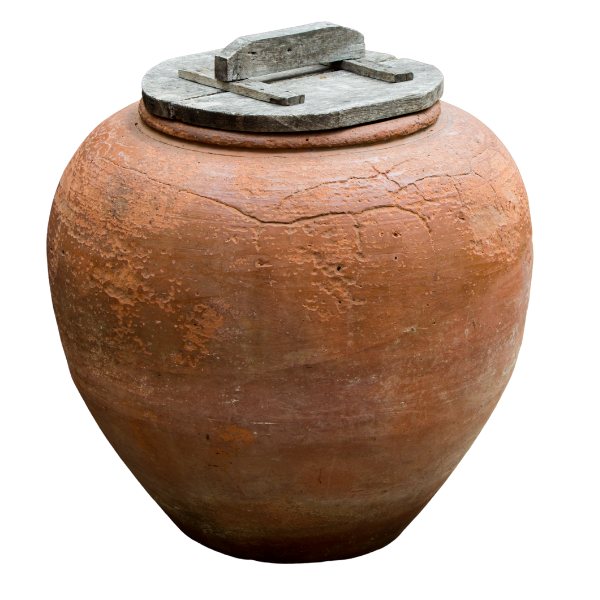
Fermentation requires minimal energy, you only need three things, a vessel, salt and time. Well maybe four – the food item you wish to ferment.
Food doesn’t need us to save it; it needs us to provide the right conditions – the bridge to resilience.
Every jar is a quiet collaboration between time, microbes, and care.
A kitchen that ferments is a kitchen that is unplugged from the fragile “just-in-time” supply chain. It turns a summer glut into a winter feast without a freezer.
As Sandor Katz suggests, this act reclaims ancient survival skills that make us less dependent on industrial systems.
FOODS THAT FEED THE GUT
Fermented foods are very powerful and they help support your body’s vital system.
There’s a natural process that it undergoes where microorganisms like bacteria and yeast breaks down the carbohydrates into acids and enzymes. In essence, it’s pre-digesting the food and making nutrients more available to you.
Sauerkraut and kimchi, fermented cabbage, provides probiotics, along with fiber, vitamin C and antioxidant. One of the easiest fermentation to get started on.
Kiefer and yogurt even though these are dairy options, there are some non-dairy ones available and they are rich in diverse probiotic strains.
Miso and Tempeh, this is where your fermented products add umami flavor to your dishes, along with all the benefits of a plant based protein.
Kombucha: A fizzy, fermented tea that you either love or hate – delivers probiotics and organic acids.
Sourdough Bread: The long fermentation process in sourdough creates a chemical environment that “pre-digests” these complex components before they even reach your stomach.
WHAT WE LOSE WITHOUT LIVING FOOD
There are studies showing that our obsession with sterility has inadvertently led to the rise in modern inflammatory disease diseases, because when we remove life from our diet through ultra processing and over sterilization, we are basically starving our internal ecosystem.
The lack of microbial diversity forces the body to work harder to perform basic biological functions, often leading to systemic breakdown.
Let me briefly highlight the consequences of a sterile diet – without microbes to synthesize vitamins or breakdown anti-nutrients we suffer from what is called hidden hunger – eating enough calories but failing to absorb essential minerals.
And then there is something called immune boredom – in essence we are not providing the immune system with enough training by sterility.
Chronic inflammation – this is very prevalent in our society right now. An imbalance of the gut flora weaken the gut lining. And this allows inflammatory markers to leak into your bloodstream. It has been linked with mood disorders.
The Restoration Process
Here’s what happens when you incorporate fermented food into your diet, you are now creating an environment that is called microbial rewilding. You see these foods don’t pass through. They interact with the resident bacteria to lower pH thus creating an acidic environment that inhibits pathogens.
They reinforce the barrier strengthening the mucosal lining of the gut. They send signal to your brain to calm the nervous system.
So you are quite effectively a host and it’s microscopic allies working as one unit because when you feed the microbes, you are feeding yourself.
PRESERVATION AS PROTECTION
I am fascinated by how these ancestral techniques do more than just stop rot—they transform the chemistry of the food to create a barrier from spoilage. While our modern refrigeration slows everything down, these ancestral methods use active intervention to make food inhospitable to pathogens. Before refrigeration, we relied on salt, acid, smoke, and time.
Let’s begin with pickling, food in vinegar and the transformation happens because we drop the pH level below 4.6 and most foodborne pathogens cannot survive in such a high acidic environment.
Salting and curing, salt draws the water out of the microbial cells, basically dehydrating and killing the bacteria.
Drying, a simple process of removing moisture through sun or air and without enough water, microorganisms, and enzymes that caused spoilage just don’t function.
Smoking, smoking isn’t just done for the flavor. It contains over 400 compounds which act as a natural antimicrobials and antioxidants that coats the surface of the food.
These methods keep food safe and extend life, especially because they were used in tandem like salting before curing etc. Using multiple methods kept food shelf stable for months.
TIME IS THE MISSING INGREDIENT
Slowing down in a world of instant is a radical act, but fermentation requires that you shift from controlled to cooperation.
It requires that you provide the and then step back and let the microbes do their work.
What Time Transforms The Flavor Arc:
Time allows for the development of complex esters and organic acids. The longer your fermentation sits the more it develops a depth and a certain funk that is the signal of rich microbial activity.
A molecular restructure and happens during this period because it takes time for bacteria to physically dismantle gluten proteins and neutralize phytic acid.
They really are no shortcuts to the availability that long fermentation provides. Different bacteria take turns lower the pH each doing their job and then passing it onto the next until the environment is perfectly preserved and safe.
The Art of Observation
In time you develop a sixth sense for this whole process, you start by watching the brine go cloudy or see in the first bubbles, you smell the transition from raw to tangy to bright. You learn to trust that if you give the microbes the right amount of salt and temperature, they will do their job and prevent food spoilage, while gifting you with all these beneficial microbes.
You embrace and honor time because you begin to understand that you aren’t just making food your cultivating resilience.
PRESERVATION IS AN ACT OF LOVE
That jar on your counter it’s not just sitting there quietly it is a bridge between the labor of the earth and the vitality of your future self. By slowing down the decay of a harvest, you are physically manifesting the resilience needed to sustain your own biology.
The Threshold of Reciprocity
When you ferment, you are working in conjunction with a living system that repays you with the four pillars of health:
Gut Resilience: helps you to withstand the stresses of modern life from antibiotics to environmental toxins.
Immune Strength: by training your immune system that is by introducing safe challenges, you keep your immune cells alert, and this reduces the likelihood of chronic inflammation.
Emotional Regulation: Through the gut-brain axis, your microbes produce the neurotransmitters that stabilize your mood.
Food Sovereignty: I could write numerous articles on this one but here I have to reduce it to one tiny paragraph so let me stress that the shift from consumer to producer is a quiet revolution. When you master fermentation, you reclaim the power over your own biology that was outsourced to factories decades ago. You no longer rely on a corporation to provide “probiotic supplements” or “fortified” bread; you create them in your own kitchen using basic elements.
Mastering these techniques—salt, acid, and time—frees you from the industrial food chain. You become a producer of health rather than just a consumer of products. To preserve is to acknowledge that nothing is wasted and everything has the potential for a “second life” that is more nourishing than the first.
To save food is to honor the labor that grew it.
YOUR JAR IS A THRESHOLD
To keep ferments safe:
These simple rules are what separate successful preservation from spoilage. By following them, you are acting as a guardian for the beneficial Lactic Acid Bacteria that transform your food.
The Logic of the Rules Submergence (The Anaerobic Seal):
That anaerobic seal is the most critical boundary in fermentation. The object here is to starve the organisms that need oxygen so you can allow the organisms that are salt tolerant acid-producing helpers to flourish.
The “Nose” Test: our senses are fine-tuned – even when we haven’t been practicing this for an even when we haven’t been practicing this for a while, our sense of smell will come back pretty quickly. You will recognize the smell of a healthy ferment, which should smell bright and vinegar or even funky like cheese and you will know when it smells putrid or sulfur. It’s wrong and it should be discarded.
Cold Storage: this is the pause button. Once the flavor has reached its peak moving the jar to the refrigerator, slows down the fermentation process and this preserves the crunch and acidity for months without killing the living cultures.
NOTES: The Return of Ancestral Wisdom
This “old knowledge” is a form of biological literacy.
Modern industrial food relies on a “scorched earth” policy.
To ensure a product can sit on a shelf for years, it must be stripped of its enzymes, bacteria, and vitality.
In contrast, your fermentation jar is a living organized habitat.
Pro Tip: If your vegetables keep floating, use a “weight”—a clean stone, a smaller glass jar, or even a large folded cabbage leaf—to maintain that critical anaerobic seal.
Reflection
The jar teaches what the world forgets:
That time is not the enemy.
That change can be nourishment.
That life continues when tended.
SUGGESTED READING
For those who want to explore the science and ancestral roots of fermentation:
- “Health benefits of fermented foods” — *Journal of Applied Microbiology*
- “The role of lactic acid bacteria in gut health” — *Frontiers in Microbiology*
- “Traditional food fermentation as a household technology” — *Food Control*
- “Microbiome and immune system interactions” — *Nature Reviews Immunology*
- “Fermented foods, probiotics, and mental health” — *Nutrients*
These studies echo what cultures have always known: living food sustains living systems.
“Sources”
→ Article No. 5 → Return to The Resilient Table